

There is something quietly radical about linocut printing. It takes one of the humblest domestic materials imaginable - the linoleum floor tile - and uses it to make images that have appeared on gallery walls, in political pamphlets, on revolutionary posters, and in the studios of some of the most significant artists of the twentieth century.
For us at Ritualis Press, it is also the medium at the heart of everything we do. We make tools for printmakers, and so understanding where lino printing came from - who invented it, who legitimised it, who pushed it to its limits - feels like understanding the ground beneath our own feet.
This is the history of linocut printing: from its unlikely origins as a Victorian flooring patent, through its adoption by the Expressionists, the modernists, and the political printmakers of the mid-century, to the vibrant community of artists using it today.
What Is a Linocut?
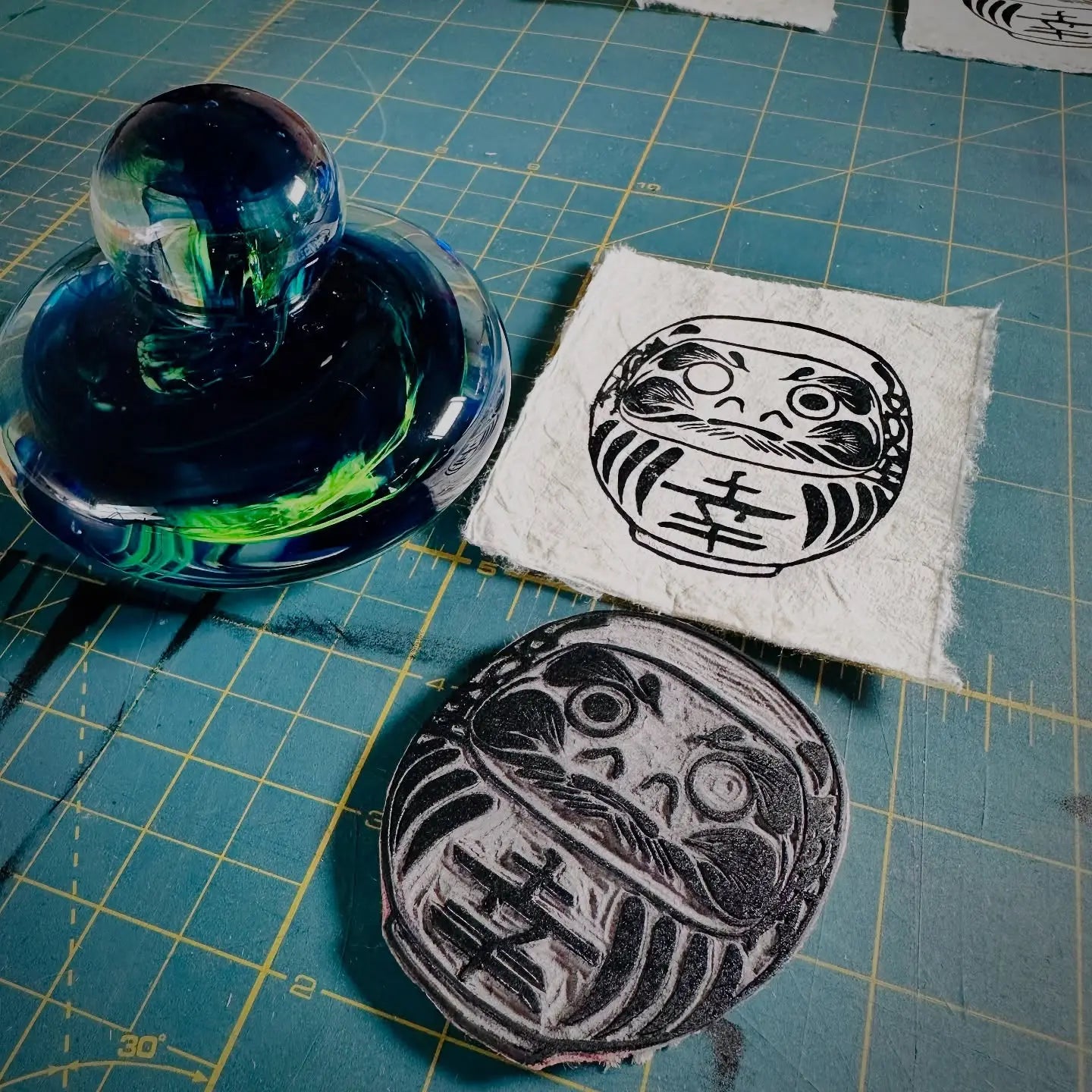
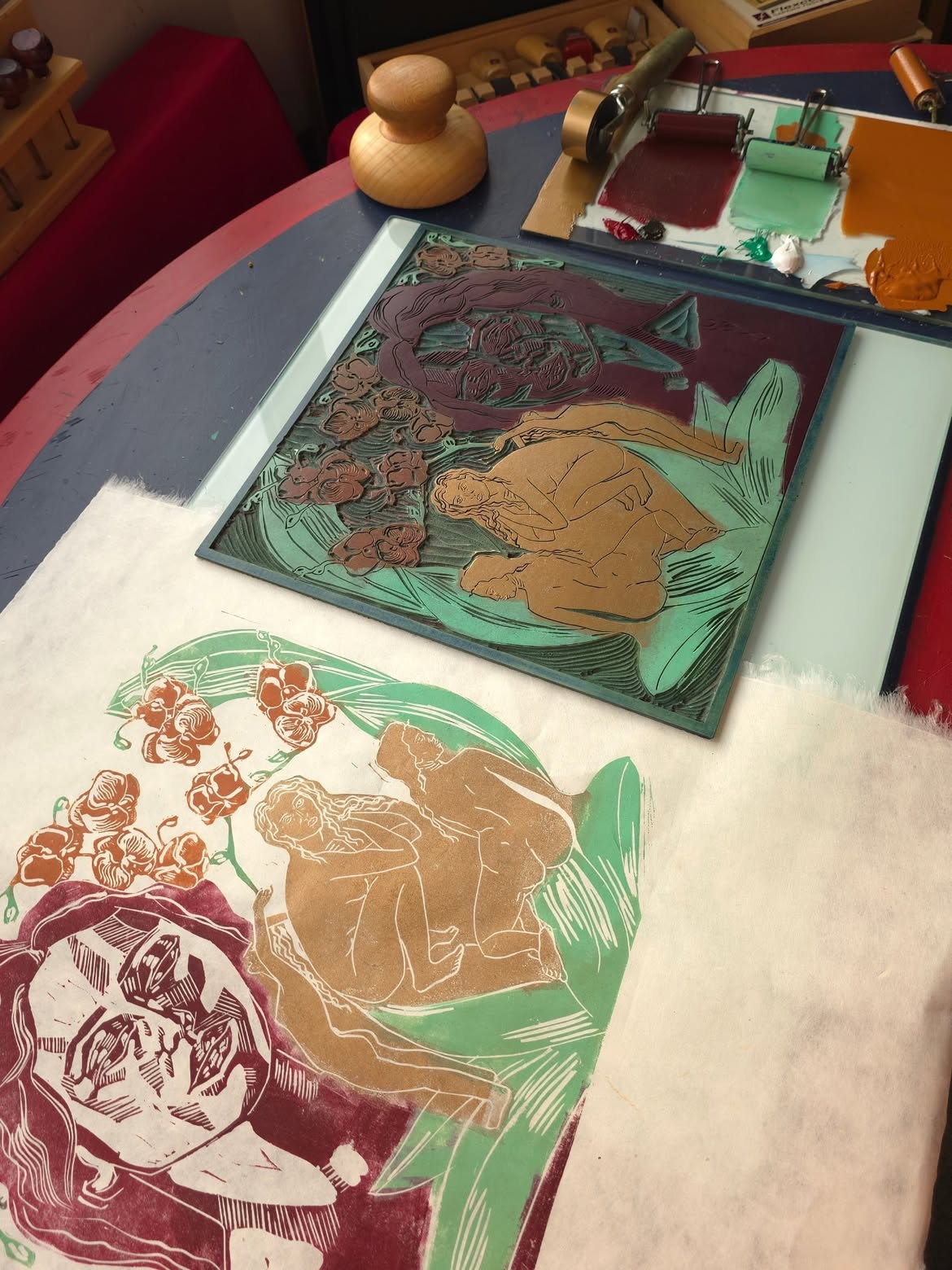
A linocut is a type of relief print. The artist carves into a flat sheet of linoleum - removing the areas that should not print - and what remains raised is inked and pressed onto paper. The logic is exactly the same as a woodcut or a rubber stamp, just with a different material beneath the blade.
Linoleum has a smooth, consistent surface with no grain, which makes it respond very differently to the cutting tool than wood does. Lines can travel in any direction. Curves are easy. Fine detail is achievable in a way that wood, with its natural resistance, often is not. It is forgiving enough for beginners and expressive enough for masters.
The lino sheet used for printmaking today - typically grey or brown, mounted on a hessian or canvas backing - is essentially the same material Frederick Walton patented in 1860. What changed was what artists decided to do with it.
The Origins: Linoleum Was Never Meant to Be Art
Frederick Walton, a British inventor, patented linoleum in 1860. The name combines the Latin words for linseed oil (linum) and oil (oleum): the material is made by oxidising linseed oil and mixing it with cork dust, wood flour, and pigments, then pressing it onto a jute or canvas backing. It was durable, water-resistant, and cheap enough to floor the kitchens and hallways of Victorian Britain.
Its first use was entirely practical. Linoleum replaced stone floors and bare boards in working-class homes. It was mass-produced, standardised, and critically - flat, smooth, and consistent. Nobody designing it for flooring purposes imagined that artists would one day start carving into it.
The transition from floor to studio happened gradually in the 1890s. The earliest records of linoleum being used as a printmaking surface come from German-speaking Europe, where art educators began using it as a more accessible alternative to woodblock carving. Linoleum was cheap, widely available, and required less skill to cut than wood. It became a teaching material before it became an art material - and that stigma, fair or not, followed it for decades.
What Linocut Is Called Around the World
Language reveals how seriously a culture takes something. Linocut goes by many names:
- English: Linocut, lino print, linoleum block print
- German: Linolschnitt, Linoleumdruck
- French: Linogravure
- Spanish: Linograbado
- Italian: Linoleografia
The multiplicity of terms reflects how simultaneously the medium spread across Europe and the Americas in the early twentieth century. Different traditions developed independently before eventually influencing one another.
Linocut Art: 1895 to 1920
Franz Cizek and the Art Education Revolution
The Austrian educator Franz Cizek is often credited as one of the first to bring linoleum into an intentional artistic context. Teaching at the Vienna School of Arts and Crafts in the late 1890s, Cizek used linoleum cutting as a tool for creative expression in children's art education. His approach - letting students carve freely, without the technical demands of woodcut - produced work of remarkable spontaneity. His influence spread through Europe's art education networks and helped establish linocut as a legitimate printmaking medium, even if it continued to be seen as a junior form of woodcut.
Emil Orlik and the Bridge to Woodcut Tradition
Emil Orlik, a Czech-German artist who had trained in Japan and brought a deep knowledge of woodblock printing back to Europe, was among the first professional artists to take linoleum seriously as a print medium in its own right. His early prints from the 1890s - including the Small Woodcuts portfolio held at MoMA - carry the influence of Japanese printmaking: clean lines, considered negative space, applied to a new material. Orlik helped demonstrate that linoleum was not a substitute for wood but a surface with its own possibilities.
The German Expressionists
The most significant group of early linocut artists were the German Expressionists, particularly the artists of Die Brücke (The Bridge), founded in Dresden in 1905. Artists including Ernst Ludwig Kirchner, Erich Heckel, and Max Pechstein embraced printmaking as central to their practice, not peripheral to it. They were drawn to the rawness that cutting tools produced, the bold contrasts of black and white, the way a print could be pulled quickly and cheaply and distributed widely.
Kirchner's prints are striking for their aggressive energy - you can see this quality in works like his Brücke Manifesto woodcut (1906) at MoMA and the portrait prints from 1918 including Father Müller and Head of Ludwig Schames. Heckel's prints carry an equally powerful psychological depth. The Expressionists did not use the medium because it was easy. They used it because it suited what they wanted to say. In their hands, the relative crudeness of the cut became a feature, not a limitation.
Vasily Kandinsky, who would later become one of the great theorists of abstract art, made prints during this period that experimented with colour and form in ways that prefigured his later painting. He saw printmaking as a way of thinking through visual problems quickly and inexpensively.
Gustave Baumann
In the United States, Gustave Baumann was doing something quite different with the same material. A German-born artist who settled in New Mexico, Baumann developed a colour printmaking practice of extraordinary refinement - printing multiple blocks, one colour at a time, to produce landscape prints of great warmth and subtlety. The Art Institute of Chicago holds 191 of his works, including his earliest colour prints such as Old Munich (1905) and New Mexico landscapes like Winsor Canyon (1920). His work helped establish that linocut was capable of the same colour complexity as woodblock, in the hands of someone willing to master registration and reduction printing.
Linocut Art: 1920 to 1960
The Grosvenor School and Speed in Print
The single most influential group in the history of linocut printmaking was the Grosvenor School of Modern Art in London, founded in 1925 by Claude Flight. Flight was a passionate advocate for linocut as a democratic, modern medium - fast, printable in quantity, affordable, and capable of capturing the energy of modern life in a way that slower processes could not.
The artists he inspired produced linocuts that are now among the most recognisable of the twentieth century. They depicted the rhythms of the modern city: crowds in motion, cyclists, rugby players, fairground rides. They used diagonals and curves to convey speed. They printed in brilliant, flat colour without modelling or shadow. The Metropolitan Museum of Art has a dedicated lecture on the Grosvenor School and its influence that is well worth an hour of your time.
Sybil Andrews is perhaps the most beloved of the Grosvenor School artists. Her linocuts capture motion with a rhythmic, almost musical quality. The Met holds a large collection of her work, including The Gale (1930), Speedway (1934), Racing (1934), Tillers of the Soil (1934), and Bringing in the Boat (1933).
Cyril Power brought an architect's eye to linocut, structuring his compositions around bold geometric forms that pulse with implied movement. His London Underground series is essential viewing: The Tube Train, The Tube Station, and The Tube Staircase are all at the Met. So are The Vortex (1929), The Runners, and The Eight. The British Museum also holds Power's work in their collection.
Swiss artist Lill Tschudi studied at the Grosvenor School before training in Paris with Fernand Léger and Gino Severini. Her prints carry a sharp European energy: Ice Hockey, Street Decoration, and Tour de Suisse are all at the Met.
Australian artist Ethel Spowers travelled to London specifically to study with Claude Flight, and brought the Grosvenor School aesthetic back to Australia. Her Bank Holiday (1935) is held at the National Gallery of Victoria in Melbourne - a beautifully composed image of leisure and light.
Pablo Picasso
No history of linocut would be complete without Pablo Picasso, who came to the medium relatively late in his career, in the late 1950s. Picasso worked in Vallauris in the south of France and discovered reduction linocut - a process where the same block is progressively carved and printed in multiple colours, destroying previous layers as you go. There is no going back. Each state is irreversible.
The Metropolitan Museum of Art holds 147 of Picasso's linoleum cuts from the Kramer Collection, documented in a full scholarly publication. Individual works at the Met include Portrait of a Woman, after Lucas Cranach II and Bacchanal: Flutist and Dancers. MoMA holds Still Life with Glass Under the Lamp (1962), one of his finest reduction linocuts. Picasso's adoption of the medium finally put to rest the idea that linocut was a minor or subordinate form of printmaking.
Political Printmaking: Leopoldo Méndez and the Mexican Tradition
In Mexico, linocut took a different path entirely. The Taller de Gráfica Popular (Workshop of Popular Graphics), co-founded by Leopoldo Méndez in 1937, used linocut and woodcut as tools for political communication. They made posters, pamphlets, and broadsheets. Their prints were designed to be understood at a glance, reproduced in quantity, and to reach people who might never enter a gallery.
The Art Institute of Chicago holds the largest North American collection of Méndez's work, including Firing Squad and his extraordinary Homage to Posada. LACMA holds his In the Hands of the Gestapo (c.1942). The Met publishes a thorough essay on printmaking in Mexico 1900 to 1950 that places Méndez and the Taller in full context. The Taller de Gráfica Popular demonstrated that linocut could be both art and instrument - that beauty and purpose did not need to be separated.
Elizabeth Catlett
Elizabeth Catlett, an African-American sculptor and printmaker who eventually settled in Mexico and worked with the Taller de Gráfica Popular, produced linocuts that combined the political directness of the Mexican tradition with a deep engagement with the African-American experience. Her series The Black Woman (1946 to 1947) is one of the landmarks of twentieth-century printmaking.
MoMA holds the complete series, including I Am The Black Woman and And a Special Fear for My Loved Ones. The Art Institute of Chicago holds three individual prints from the series: In Other Folk's Homes, Special Houses, and And a Special Fear for My Loved Ones. Catlett's work reminds us that linocut has always been available to artists working outside mainstream institutions - it requires less equipment, less space, and less money than almost any other printmaking form.
The Medium's Legitimacy: A Note Worth Making
For much of its early history, linocut was dismissed by serious printmakers as a tool for students and beginners. The critic Aylmer Perry, writing in 1938, felt compelled to argue in its defence: Linoleum may be a substitute for wood, but it is a medium in itself worthy of the consideration of the best block printers.
That defence should not have been necessary, but it was. The arts have always had hierarchies, and linocut sat near the bottom of the printmaking hierarchy for most of the first half of the twentieth century. What changed was not the medium. It was the artists who chose it. When Picasso picked up a gouge in Vallauris, the argument was over.
Linocut Today: The Return of the Handmade
There is something happening in printmaking right now that we at Ritualis Press see reflected in our own community every day. After decades of digital image-making, artists across the world are returning to the physical, the handmade, the slow. Linocut is part of that return.
The reasons are various. Some artists are attracted to the simplicity of the process - the directness of the relationship between hand, tool, and surface. Others value the imperfection, the way no two prints from the same block are ever identical. Others are drawn to the history: the sense of being part of a tradition that includes Kirchner and Picasso and Catlett and Andrews.
And some, we think, are drawn to the ritual of it. The setting up, the inking, the pulling of the print. The moment of lifting the paper and seeing what the block has given you. That moment is the same whether you are using a Printmaking Wooden Baren by hand, pressing with our Glass Baren for fine detail, or running a sheet through an A3 Lino Press. The technology changes. The ritual does not.
Making the Work: Tools Across the Tradition
One thing the history of linocut makes clear is that the tools have always mattered. The Grosvenor School artists worked with simple hand tools and printed by hand or on tabletop presses. Picasso worked in a professional print workshop. The Taller de Gráfica Popular had communal studio equipment that allowed them to print in quantity.
What all these artists shared was an intimate relationship between tool and material. The cutting tools you use determine the character of your line. The ink roller determines how your ink sits on the block. The press or the baren determines the pressure and the quality of the transfer.
Today, a printmaker setting up a home studio can access tools that the Grosvenor School artists would have found extraordinary: portable presses that fit on a kitchen table, precision barens, inks developed specifically for the demands of relief printing. Our own presses, from the A5 to the A4, the A3, and the A2 Textile Lino Press, are designed around the same principles those early artists were working toward: consistency, control, and the ability to produce editions of real quality.
The history of linocut is, in part, the history of tools getting better and reaching more people. That is a history we are glad to be part of.
See the Works Online
Every work mentioned in this article is publicly accessible online, free of charge, through the museum collections below. If this history has sparked something, these are the best places to start looking.
The Metropolitan Museum of Art
- Sybil Andrews: The Gale, Speedway, Racing, Tillers of the Soil, Bringing in the Boat, Concert Hall
- Cyril Power: The Tube Train, The Vortex, The Runners, The Eight, The Tube Staircase
- Lill Tschudi: Ice Hockey, Street Decoration, Tour de Suisse
- Pablo Picasso: Linoleum Cuts: Kramer Collection (147 works), Portrait of a Woman after Lucas Cranach II, Bacchanal: Flutist and Dancers
- Leopoldo Méndez: Plate from Estampas de la revolución Mexicana + Essay: Printmaking in Mexico 1900 to 1950
- Gustave Baumann: Salt Creek
- Erich Heckel: Roquairol, Straight Canal
- Emil Orlik: Portrait of Ferdinand Hodler (1904)
MoMA
- Ernst Ludwig Kirchner: Artist page, Brücke Manifesto (1906), Father Müller (1918), Head of Ludwig Schames (1918)
- Erich Heckel: Artist page
- Vasily Kandinsky: Artist page
- Emil Orlik: Small Woodcuts portfolio
- Pablo Picasso: Still Life with Glass Under the Lamp (1962), All MoMA linoleum cuts
- Elizabeth Catlett: The Black Woman (complete series), I Am The Black Woman
- Exhibition: German Expressionism - The Graphic Impulse
Art Institute of Chicago
- Gustave Baumann: Full collection (191 works), Old Munich (1905), Winsor Canyon (1920)
- Elizabeth Catlett: In Other Folk's Homes, Special Houses
- Leopoldo Méndez: Artist page, Firing Squad, Homage to Posada
British Museum and National Gallery of Victoria
- Cyril Power: British Museum collection
- Ethel Spowers: Bank Holiday (1935) at NGV Melbourne
LACMA
- Leopoldo Méndez: In the Hands of the Gestapo (c.1942)
Tate
- Ernst Ludwig Kirchner: Artist page at Tate
Final Thought
Linocut started as a floor. It became a medium that Picasso used in his seventies, that Mexican revolutionaries used to reach the people, that Sybil Andrews used to capture the feeling of a crowd in motion. It was dismissed for decades as a minor form, and it outlasted every critic who dismissed it.
It is, in the end, a medium about directness. The hand moves, the tool cuts, the ink transfers. There are not many steps between intention and result. For an artist who wants to make marks and make them count, that directness is not a limitation. It is the point.
Printing is a ritual. It always has been.

Choosing the Right Paper for Hand Printing Lino Blocks
How to Lino Print for Beginners: A Complete Step-by-Step Guide