

Every craft has its own language. Linocut and relief printmaking are no different - and when you are new to the field, the terminology can feel overwhelming. This glossary covers the essential terms used in linocut, linoleum printing, and related relief printing techniques: from the tools you hold to the concepts that define how the process works. Use it as a reference while learning, or as a starting point for understanding the wider world of printmaking.
A
Artist's Proof (A/P)
An impression pulled outside the main numbered edition, traditionally reserved for the artist. Artist's proofs are usually marked "A/P" or "A.P." and are identical in quality to the edition prints. The number of artist's proofs is typically limited to around 10% of the edition size.
Artists' Proof vs. Working Proof
An artist's proof is a finished print outside the numbered edition. A working proof is a print pulled during the development of the block - used to check the carving, ink coverage, or registration before the edition begins. Working proofs are not considered part of the edition.
Aquatint
An intaglio printmaking technique that produces tonal areas rather than lines. Powdered resin is applied to a metal plate and heated until it fuses. When placed in acid, the acid bites into the tiny gaps between the resin granules, creating a rough texture that holds ink in varying densities. Burnishing or stopping out different areas before re-biting controls the tonal range, from pale gray through to solid black. Aquatint is most often combined with line etching in the same composition to add tone to drawn lines.
B
Baren
A smooth, flat tool used to apply even pressure to the back of the paper during hand printing, transferring ink from the block to the sheet without a press. Barens are the defining tool of hand printing: they allow a printer to produce clean, even impressions on any surface without mechanical equipment. A glass baren offers focused, firm pressure ideal for fine detail and smaller blocks. A wooden baren covers larger areas efficiently and suits A4 and A5 format prints.
Bed (Press Bed)
The flat surface of a printing press on which the block and paper are placed during printing. On a platen press, the bed moves under the platen; on a cylinder press, the bed moves under the roller. The flatness and rigidity of the bed directly affect print quality.
Bite
In relief printing, the degree to which the roller picks up ink and transfers it to the block surface. Good bite requires ink at the correct viscosity - too thin and the ink flows off the roller; too thick and it does not transfer cleanly. Bite also describes how firmly a block prints - a block with good bite transfers ink fully to the paper.
Block
The material into which the image is carved for relief printing. In linocut, the block is a sheet of linoleum. In woodcut, it is a plank of wood. The block functions as the matrix - the physical object that carries the image and transfers it during printing.
Block Printing
The broad category of printing techniques that use a carved block as the matrix. Block printing includes linocut, woodcut, rubber stamp printing, and traditional Asian woodblock printing. All share the relief principle: raised surfaces print, recessed surfaces do not.
Brayer
Another name for an ink roller - a cylindrical tool with a handle used to apply ink to the surface of a printing block. Brayers come in various widths. A 6 cm roller gives precise control for smaller blocks and stamps; a 12 cm roller is the standard for most linocut work; an 18 cm roller covers large format blocks in one or two passes.
C
Carving
The process of removing material from the block surface to create the image in relief. In linocut, carving is done with gouges - V-gouges for lines and detail, U-gouges for clearing larger areas. The fundamental rule of relief carving: what you remove will not print; what you leave will.
Chine-collé
A technique in which thin decorative or textured paper is bonded to the printing paper during the printing process. The block prints onto both surfaces simultaneously. Chine-collé adds color, texture, and visual complexity to relief prints and is often used in combination with linocut.
Color Reduction Linocut
A multicolor linocut technique in which all colors are printed from a single block. After printing the first color, more linoleum is carved away and the second color is printed on top. The process repeats for each color. Because material is permanently removed between passes, the block cannot be used to reprint earlier colors, and the edition size must be set before printing begins. Also called the suicide method. Full details under Reduction Linocut.
Color Registration
The precise alignment of two or more color passes in a multicolor linocut print. When printing the second or third color, the paper must be positioned identically to the first pass so that each color occupies exactly the right area. Misregistration shows as color gaps, overlaps, or halos around forms. Registration is managed with registration marks, jigs, or pin systems.
Collagraph
A mixed printmaking technique in which texture and material are added to a flat plate rather than carved from it. The plate is then inked and printed. Although not strictly a relief technique, collagraph is often practiced alongside linocut.
Counter (White Space)
The carved-away areas of a block that do not print. Managing the balance between the printed (relief) areas and the counter areas is central to linocut design - particularly in text, where counters inside letters like "o" and "p" are critical to legibility.
D
Drypoint
An intaglio technique in which a sharp metal point (or diamond-tipped tool) is dragged directly across a copper or zinc plate, displacing metal and raising a rough burr alongside the scratched groove. Unlike etching, no acid is used. The burr holds extra ink during printing and produces a characteristic soft, velvety line quality unique to drypoint. The burr wears down quickly under press pressure, so drypoint editions are typically small. Often combined with etching or aquatint.
Deckle Edge
The naturally irregular, feathered edge of handmade or mould-made paper, formed where the pulp meets the frame during paper production. Deckle edges are considered a mark of quality in fine art printing and are often left visible in editions as part of the presentation.
Draping
Allowing a dampened sheet of paper to conform to the surface texture of a block before inking and printing. Draping is used in some hand printing methods to maximize contact between paper and block, improving ink transfer.
E
Engraving (Line Engraving)
An intaglio technique in which lines are cut directly into a metal plate - usually copper - using a burin, a small hardened steel tool with a sharpened tip pushed by hand. Engraving produces precise, clean lines that swell and taper as the burin turns. It is one of the oldest intaglio techniques, used extensively from the 15th century for reproducing drawings and maps. The technique requires significant skill and strength; lines cannot be easily corrected once cut.
Etching
An intaglio printmaking technique in which a metal plate (copper, zinc, or steel) is coated with an acid-resistant ground, then drawn into with a sharp needle that exposes the bare metal. The plate is immersed in an acid bath, which bites into the exposed lines. The depth of the bite determines the line's width and ink-holding capacity. After removing the ground, the plate is inked, the surface wiped clean, and the image transferred to dampened paper under high press pressure. Etching allows a looser, more spontaneous line quality than engraving and has been used by artists from Rembrandt to Goya.
Edition
The complete set of prints pulled from a single block or set of blocks, all considered equivalent in quality. Editions are numbered (e.g., 3/20 means the third print from an edition of twenty). Once the edition is complete, the block is either destroyed or marked to prevent further unauthorized printing.
Editioning
The process of producing the full set of prints that make up an edition: inking the block, printing each sheet, checking quality, allowing drying, and numbering and signing. Consistent ink mixing, paper selection, and pressure application are essential for an even edition.
Embossing
Creating a raised impression in paper without ink. In linocut, embossing is produced by printing with no ink on dampened paper - the paper is pressed into the carved recesses, creating a three-dimensional surface texture. Also called blind embossing.
F
Flat Color
A single, unmodulated layer of ink covering a defined area of the print without gradation or visible texture. Flat color is characteristic of linocut's graphic aesthetic and is one of the technique's natural strengths.
French Offset
A registration method in which the image from one block is transferred to a second block by running both through the press together without ink. The offset impression on the second block acts as a guide for the next color's placement.
G
Giclee
A high-quality digital inkjet print produced from a digital file using archival pigment-based inks on fine art paper or canvas. The term comes from the French word for "to spray." Giclee prints are reproductions rather than original prints in the traditional sense - no matrix is carved, etched, or worked. They are used in fine art contexts to distinguish quality digital reproduction from standard inkjet output. Giclee does not belong to the traditional printmaking family (relief, intaglio, planographic, stencil) but appears frequently alongside fine art editions.
Ghost Print
A print taken from an already-used block without re-inking, producing a lighter, partial impression. Ghost prints are often used experimentally or incorporated as layers in mixed-technique work. The "ghost" carries the memory of previous inking and can create atmospheric, soft-edged effects.
Gouge
The primary carving tool in linocut, with a metal blade set in a handle. The two main profiles are the V-gouge (pointed V cross-section, for cutting precise lines and contours) and the U-gouge (rounded U cross-section, for clearing broad areas of material). Our lino cutting set includes both profiles, while the Abig set with screw fitting offers interchangeable blades for professional use.
Gradation / Gradient
A transition between two tones or colors within a single print pass. In linocut, gradations are achieved by blending two ink colors on the slab before rolling, producing a smooth color shift across the block. Also called a rainbow roll or split-fountain technique.
H
Hardboard (MDF) Block
A dense fiberboard material sometimes used as a relief printing surface. Hardboard does not have the carving qualities of linoleum but can be used for collagraph and surface-applied relief techniques.
Hors Commerce (H.C.)
French for "outside of commerce." An impression pulled outside the numbered edition and not intended for sale - similar to an artist's proof. H.C. impressions are typically made for archival, exhibition, or presentation purposes.
I
Impression
A single print produced by inking and printing from a block. Also used as a synonym for "print" when discussing editioning. Each numbered print in an edition is one impression.
Ink
The pigmented medium applied to the raised surface of the block and transferred to the printing substrate. Relief printing inks come in oil-based, water-based, and hybrid formulations. Our Renesans H2Oil ink is a hybrid oil-water formulation that maintains the color depth of oil-based inks while cleaning up with water - well suited to both hand printing and press work.
Ink Slab / Inking Plate
A flat, non-porous surface used for mixing and rolling out ink before application to the block. Glass and acrylic slabs are common. Ink is spread onto the slab with a palette knife, then rolled out to a thin, even layer before being transferred to the roller.
Inking
The step in the printing process where ink is applied to the block surface using a roller. Correct inking - a thin, even layer with good tack - is the single most important factor in print quality. Over-inking fills fine details; under-inking produces patchy, incomplete impressions.
Intaglio
The opposite of relief printing. In intaglio, ink is forced into recessed lines and recesses in the plate, the surface is wiped clean, and paper is pressed into the plate to lift the ink from below. Etching, engraving, and drypoint are intaglio techniques. Understanding intaglio helps clarify the logic of relief printing by contrast.
J
Japanese Tissue
Extremely thin, strong handmade paper used in fine art printing. Japanese tissue absorbs ink readily and conforms well to block texture, making it ideal for pulling delicate impressions. Also used in chine-collé applications.
K
Key Block / Keyline Block
In multicolor linocut, the key block is the first block cut, typically containing the main lines and structure of the composition. All subsequent color blocks are registered to the key block. The key block is usually printed last, in the darkest or most defining color.
L
Letterpress
A relief printing technique in which raised metal or wood type, ornaments, or photo-etched printing plates are inked and pressed directly onto paper. Historically the dominant method of commercial and book printing from Gutenberg's invention of movable type in the 15th century through the mid-20th century. Today letterpress is practiced as a craft and fine art form, valued for its characteristic impression or "bite" into soft cotton paper and its direct, tactile quality. Like linocut, letterpress is a relief technique: raised surfaces print.
Lithography
A planographic printing technique based on the chemical principle that grease and water repel each other. The image is drawn or painted directly onto a flat limestone slab or grained aluminum plate using greasy media - litho crayon, tusche (liquid litho ink), or other greasy materials. The surface is chemically treated so that damp areas repel oil-based ink and image areas accept it. Lithography can reproduce the full range of drawing marks - including brushwork, wash, and fine line - and produces prints with a richness and directness not achievable in relief or intaglio. Invented in 1796 by Alois Senefelder.
Linocut
A relief printmaking technique in which the image is carved into a sheet of linoleum, the surface is inked, and an impression is taken on paper or fabric. Linocut was popularized in the early 20th century as a more accessible alternative to woodcut. It is now a major fine art and craft printmaking medium. Key characteristics: bold graphic quality, clean flat color areas, and the ability to cut in any direction without concern for grain.
Linoleum
The material used as the block in linocut. Made from linseed oil, cork dust, wood flour, and pigments bonded to a burlap or canvas backing, linoleum is firm enough to hold fine detail but soft enough to carve with hand tools. The best printmaking linoleum - sometimes called "battleship lino" - is denser and more uniform than floor covering linoleum. A good quality lino sheet carves cleanly in all directions and prints consistently across the block.
Linseed Oil
The primary binder in oil-based relief printing inks. Linseed oil gives the ink its body, tack, and drying properties. The drying time of linseed oil-based inks depends on temperature, ventilation, and the ratio of oil to pigment.
Linocut Stamp
A small linocut block used as a hand stamp rather than printed with a press or baren. Linocut stamps are inked with a roller and applied by hand pressure, allowing repeat motifs to be printed across paper, fabric, and other surfaces. The technique is identical to linocut; the difference is primarily in the scale and application.
M
Mezzotint
An intaglio technique in which the entire surface of a copper or steel plate is first roughened with a serrated rocker tool so that it prints a uniform deep black. The image is then created by burnishing and scraping areas smooth - burnished areas hold less ink and print lighter or white. Mezzotint is worked from dark to light, the opposite of most drawing techniques, and produces prints with a distinctive velvety tonal range and soft gradations between dark and light. It is time-consuming and technically demanding, and has been used for portraiture and tonal reproductive work since the 17th century.
Matrix
The physical object from which a print is made - in linocut, the carved linoleum block. The matrix is the source of all impressions in an edition. "From the matrix" is how printmakers describe the direct relationship between the original carved object and each impression it produces.
Monotype
A print technique that produces a unique, one-off impression rather than a reproducible edition. In monotype, ink is applied directly to a smooth, non-absorbent surface, then transferred to paper in a single printing. Unlike linocut, monotype cannot be exactly replicated.
Monoprint
Similar to monotype, but using a matrix (such as a linocut block) that has been modified or uniquely inked for each impression. A monoprint has a matrix; a monotype does not.
Multi-Block Linocut
A linocut printed using two or more separate blocks, each carrying a different color or element of the composition. Each block is registered and printed in sequence. Multi-block work allows precise color separation and fine color control, at the cost of more complex registration.
N
Negative Space
The carved-away areas of the block that do not print. Designing effective negative space is a core linocut skill - the relationship between what is left and what is removed determines the character and legibility of the image.
O
Offset
The accidental transfer of wet ink from a freshly printed sheet to another surface (table, adjacent print, or interleaved paper). Offset can be prevented by interleaving prints with newsprint or tissue as they dry. Also a registration technique - see French Offset.
Offset Lithography
A commercial adaptation of lithography in which the inked image is transferred from the plate to an intermediate rubber blanket cylinder, and then from the blanket to the paper. The indirect "offset" transfer reduces plate wear, improves print quality on textured surfaces, and allows faster printing. Offset lithography is the dominant method of commercial book, magazine, and packaging printing. The term "offset" in everyday speech usually refers to offset lithography rather than the traditional stone-press process.
Overprinting
Printing one color layer on top of another. In multicolor linocut, overprinting creates new mixed colors where the layers overlap. The transparency or opacity of the ink determines how the layers interact - transparent inks allow additive color mixing; opaque inks block the layer below.
P
Photopolymer Etching (Solar Plate)
A photo-based printmaking technique using a light-sensitive polymer plate coated on a steel backing. The plate is exposed to UV light through a film positive or directly under sunlight (hence "solar plate"), hardening the polymer wherever light reaches it. Unexposed areas are washed away with water, leaving either a relief surface (for relief printing) or a recessed intaglio surface depending on the plate type. Photopolymer plates allow photographic and tonal detail far beyond what hand carving achieves, and require no acid. They can be printed on a standard etching press or by hand with a baren.
Palette Knife
A flat, flexible blade used to scoop, mix, and spread ink on the inking slab. A palette knife is essential for accurate ink mixing, controlling ink quantity, and spreading ink evenly before rolling. Also used to clean the slab between sessions.
Platen Press
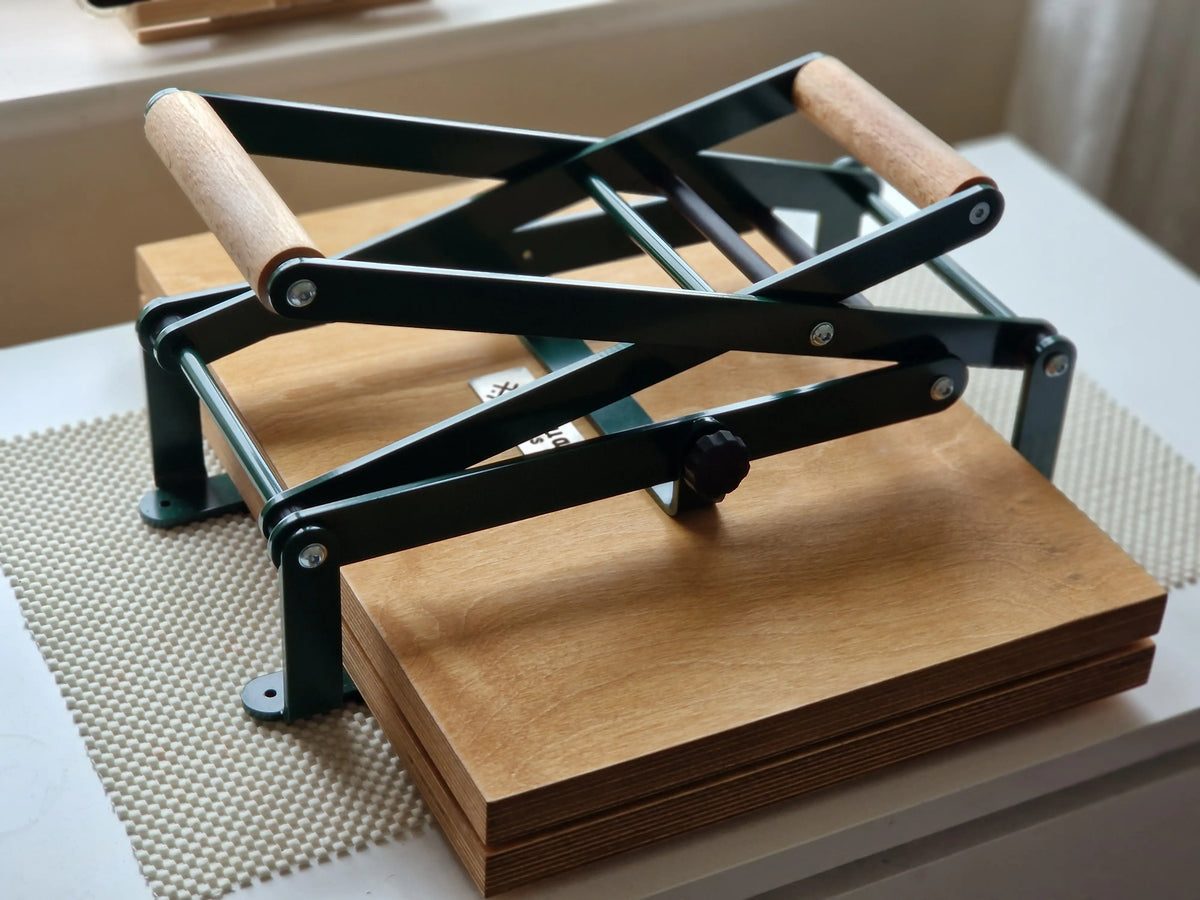
A type of printing press where the paper is pressed against the inked block (or type) by a flat plate called the platen. Platen presses apply even pressure across the full printing area in one motion - ideal for flat, even block printing.
Pochoir
A stencil printing technique using hand-cut metal or cardboard stencils and a dabber or brush to apply color. Pochoir is related to relief printing in its use of a physical barrier to define printed areas, but the ink is applied through the stencil rather than from a raised surface.
Press
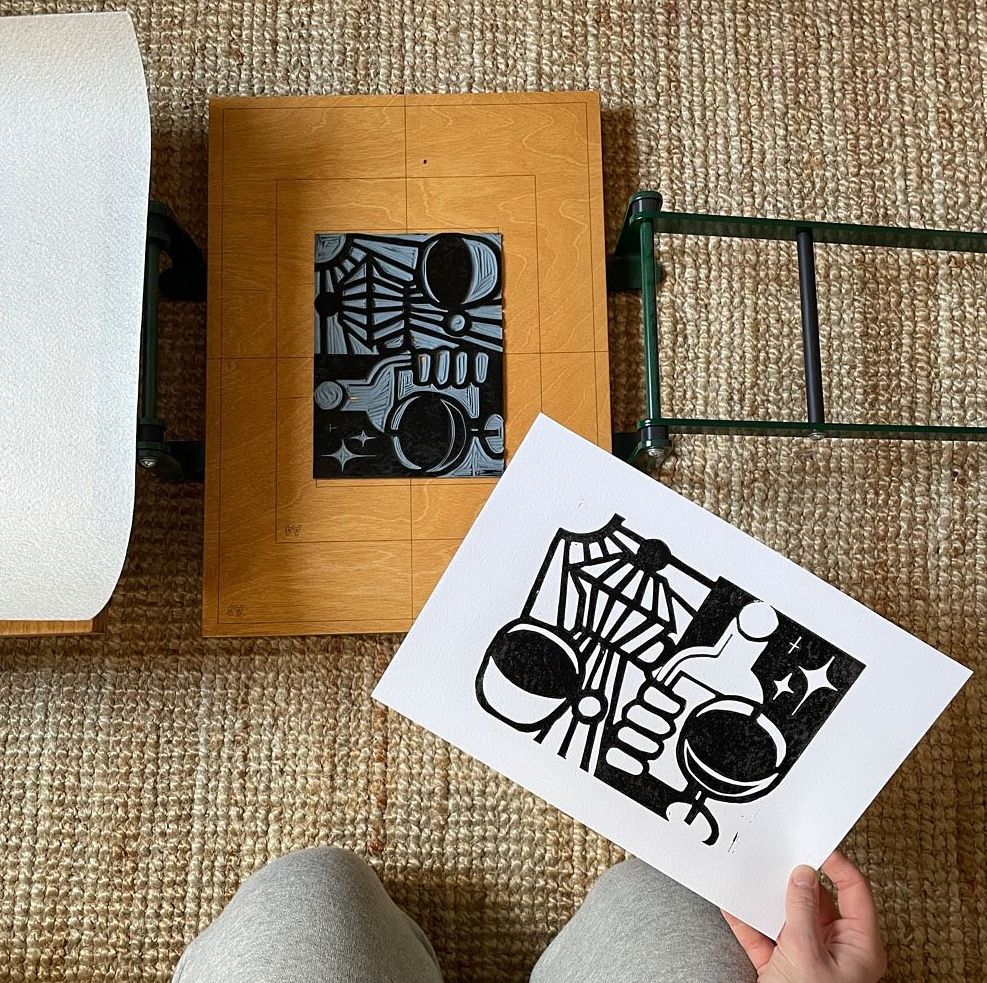
A mechanical device that applies controlled pressure to transfer ink from block to paper. For linocut, tabletop presses provide even, repeatable pressure without the need for hand rubbing. Our A5 lino press, A4 lino press, and A3 lino press are designed for linocut and relief printing blocks of the corresponding format.
A single impression taken from a block. Also the general category of art and craft objects produced by printmaking techniques. In fine art contexts, a print has value because it is produced directly from a carved or worked matrix - not a reproduction of a drawing or painting.
Printmaking
The broad discipline of creating art by transferring ink from a matrix to a support (usually paper or fabric). Major printmaking categories include relief (linocut, woodcut), intaglio (etching, engraving), planographic (lithography), and stencil (screenprinting, pochoir). Linocut is one of the most accessible entry points into fine art printmaking.
Proof
A test impression pulled from the block during the making process, used to check carving progress, ink color, registration, or paper response. Pulling proofs is a normal part of developing a linocut. Proofs are distinct from the edition - they are working documents, not finished prints.
R
Risograph
A stencil-based printing process using a digital duplicator machine manufactured by Riso Kagaku Corporation. The machine burns a stencil from a digital image, then forces soy-based ink through the stencil onto paper using a rotating drum. Risograph prints one color per pass; multicolor work requires separate runs with careful registration. The process produces a characteristic rough texture, slight misregistration between colors, and visible ink grain that gives Risograph a distinctive aesthetic. Popular with independent publishers, zine makers, and artists for short-run, low-cost production with a hand-printed feel.
Rubber Block Printing
A relief printing technique using a soft rubber or foam block as the matrix, carved with gouges or shaped with scissors and craft knives. Rubber blocks are easier to carve than linoleum and require less force, making them well suited to beginners, children, and fabric printing. They are less durable than linoleum for edition printing - fine detail degrades more quickly and the surface is more prone to tearing. Commonly used for stamps, repeat patterns, and textile surface decoration. The printing process is identical to linocut: raise surface inked by roller, pressed by hand or baren.
Rainbow Roll
A technique for creating a gradient effect across a print in a single pass by loading two or more ink colors on the roller simultaneously, blending where they meet. The roller carries the gradated color to the block, which then prints the transition in one impression.
Reduction Linocut
A multicolor linocut technique in which a single block is used for all colors by progressively carving away more material between each color printing. The first color is printed from the minimally carved block; more material is then removed for the second color, and so on. Because material is removed between passes, the block cannot be used to reprint earlier colors - the edition size is fixed before printing begins. Reduction linocut is also called the "suicide method" because the block is destroyed in the making of the edition.
Registration
The precise alignment of multiple print passes to ensure colors and layers fit together correctly. In multi-block or multi-color linocut, registration is managed using registration marks, pin systems, or jigs. Poor registration causes color shifts and misalignment visible in the final print. A pin roller is a practical tool for achieving consistent registration in repeated patterns and multi-pass work.
Registration Marks
Small marks - usually crosses or L-shaped brackets - placed outside the printing area on both the block and the paper to guide alignment between multiple print passes. Registration marks are trimmed from the finished print.
Relief Printing
The family of printing techniques in which the image-bearing areas of the matrix stand in relief (raised above the surface), are inked, and transfer ink to the paper on contact. The recessed areas are not inked and do not print. Linocut, woodcut, wood engraving, and rubber stamp printing are all relief techniques.
Roller
A cylindrical inking tool used to apply ink evenly to the surface of a printing block. Also called a brayer. The roller is rolled across an ink slab to pick up a thin, even coat, then rolled across the block to transfer it. Roller width affects how much of the block is covered per pass: a 6 cm roller suits stamps and small blocks, a 12 cm roller handles most standard linocut formats, and an 18 cm roller covers large A3 or A4 blocks in one or two passes.
S
Screenprinting (Silkscreen)
A stencil-based printing technique in which ink is forced through a mesh screen onto the substrate. Unlike linocut, screenprinting does not use a carved matrix - instead, areas of the screen are blocked to create the image. Screenprinting and linocut are often used together in mixed-technique printmaking.
Sizing
A surface treatment applied to paper to control its absorbency. Sized papers (with gelatin or starch) resist ink, allowing it to sit on the surface for sharper impressions. Unsized (waterleaf) papers absorb ink more deeply, producing softer, more textured results.
Slip Sheet
A sheet of clean newsprint, tissue, or interleaving paper placed between freshly printed sheets to prevent offset while drying. Always use slip sheets when stacking wet prints.
Strop / Leather Strop
A strip of leather used to maintain and refine the edge of carving tools between formal sharpenings. Running a gouge lightly along a strop loaded with polishing compound removes the wire edge and restores keenness. Regular stropping significantly extends the time between full sharpenings.
Substrate
The material onto which the print is made - most commonly paper, but also fabric, card, wood veneer, and other surfaces. The choice of substrate affects how ink is absorbed, the visual character of the impression, and the archival quality of the print.
T
Tack
The stickiness or adhesive quality of printing ink. Tack determines how well the ink adheres to the roller, transfers to the block, and then transfers from the block to the paper. Inks with too much tack can lift paper fibers; inks with too little tack may print unevenly. Tack is adjusted with modifier additives or by varying the ink's body.
Transfer Method
A technique for moving a design from paper to the block surface before carving. Common methods include tracing paper rubbing (the paper is flipped and rubbed down, transferring graphite to the block), photocopy toner transfer (a laser-printed image is placed face-down and rubbed with solvent), and direct drawing with chalk or pencil on a darkened block surface.
Tympan
A packing sheet placed between the press platen and the paper during printing to ensure even pressure distribution. On hand presses, the tympan is a frame that holds the paper in position. Tympan paper can also be used as a makeready layer to compensate for uneven block surfaces.
U
U-Gouge (U-Veiner)
A carving tool with a rounded U-shaped cross-section used for clearing large areas of material from the block surface. U-gouges are used after the main lines have been established with a V-gouge. They come in various widths - narrow for clearing around detail, wide for removing large background areas efficiently.
V
V-Gouge (V-Parting Tool)
A carving tool with a sharp V-shaped cross-section, used for cutting precise lines, outlines, and fine detail into the block. The V-gouge is usually the first tool used when beginning to carve a linocut, establishing the main contours before broader clearing with U-gouges.
Viscosity
The thickness or body of printing ink - its resistance to flow. Viscosity affects how the ink rolls out on the slab, how it transfers to the block, and ultimately how it prints. Relief printing inks are generally more viscous than inks for other techniques. Viscosity can be reduced with modifiers or (for water-based inks) small amounts of water.
W
Woodblock Printing
The oldest form of relief printing, originating in East Asia around the 7th century CE. Traditional Japanese woodblock printing (mokuhanga) uses water-based pigments rather than oil-based inks, multiple cherry wood blocks registered with precise corner notches called kento marks, and specific handmade papers that absorb the water-based pigment differently from Western printing papers. The result - soft, layered color with subtle tonal gradation - is characteristic of ukiyo-e prints. Chinese woodblock printing preceded the Japanese tradition and influenced its development. Western woodcut evolved separately using oil-based inks and different registration methods.
Woodcut
A relief printing technique using a plank of wood as the matrix, carved with chisels and gouges. One of the oldest printmaking techniques, woodcut requires attention to the direction of the wood grain - carving against the grain can cause splitting. Linocut is often described as a development from woodcut: it is carved with similar tools but without the constraints of wood grain.
Wood Engraving
A relief technique using the end-grain of very hard wood (usually boxwood) as the matrix, worked with fine engraving tools. Wood engraving allows finer detail than woodcut but is technically demanding and requires specialized equipment. Like linocut, wood engraving is a relief technique.
Working Proof
A test impression pulled during the development of a block, used to check carving progress, ink color, registration, or paper response. Working proofs are not part of the edition - they are working documents that record the state of the block at different stages of making. A working proof marked "W.P." with a state number (e.g., "W.P. 2/4") shows the block at a specific point in its development. Contrast with artist's proof, which is a finished impression outside the numbered edition.
Z
Zinc Plate
A metal plate used in intaglio printing (etching, aquatint). Mentioned here for reference - zinc plates are not used in relief printing but appear frequently in mixed printmaking practice and studio discussions.
Printmaking Paper Glossary
Paper choice significantly affects linocut results. These terms describe the key properties and types used in printmaking.
Absorbency
How readily a paper absorbs ink. Highly absorbent (unsized) papers produce softer, more textured impressions. Less absorbent (sized or coated) papers hold the ink on the surface, producing sharper, more defined prints.
Acid-Free Paper
Paper manufactured without acidic content, preventing yellowing and deterioration over time. All fine art edition printing should use acid-free paper to ensure archival quality.
BFK Rives
A widely used French printmaking paper, known for its smooth, even surface and consistent absorbency. A standard reference paper for linocut, etching, and lithography.
Cotton Rag Paper
Paper made from cotton fibers rather than wood pulp. Cotton rag papers are stronger, more durable, and more archivally stable than wood-pulp papers. Most high-quality printmaking papers are cotton rag or cotton-linen blends.
GSM (Grams per Square Meter)
The standard measure of paper weight. Linocut printing typically uses papers in the 90-250 gsm range. Lighter papers (under 100 gsm) require careful handling and show ink bleed more readily; heavier papers (160+ gsm) hold their shape better and are less affected by moisture from wet inks.
Laid Paper
Paper with a visible grid of fine lines caused by the wire mesh of the papermaking mould. Laid paper has a distinctive texture visible when held to light. Wove paper, by contrast, has no visible wire pattern.
Mould-Made Paper
Paper produced on a cylinder mould machine rather than entirely by hand. Mould-made papers have consistent quality and are widely used for edition printing. Higher quality than machine-made paper but less expensive than fully handmade.
Wove Paper
Paper with a smooth, uniform surface produced on a fine woven mesh mould. Most modern printing papers are wove. Contrast with laid paper.
How to Make a Block Print Stamp
Where to get inspiration for linocut prints?