

Choosing the right linocut printing press is one of the most consequential decisions a printmaker can make. A good linocut press shapes every print you pull for years. A poor one frustrates you at every step: uneven pressure, misregistered paper, edges that never quite print, a frame that wobbles under load. This article explains exactly why the Ritualis Press linocut printing press has become a trusted choice for printmakers across Europe and beyond - and how it compares to other linocut presses on the market, including Woodzilla Press, Pooki Presses, and the mass-produced presses available on Etsy, eBay, and Amazon.

1. Centering Lines
One of the most overlooked features when buying a linocut press is registration - the ability to place your paper and matrix in exactly the same position print after print. Without accurate registration, multi-layer linocut prints become a guessing game, and even single-colour prints can look off-centre on the page.
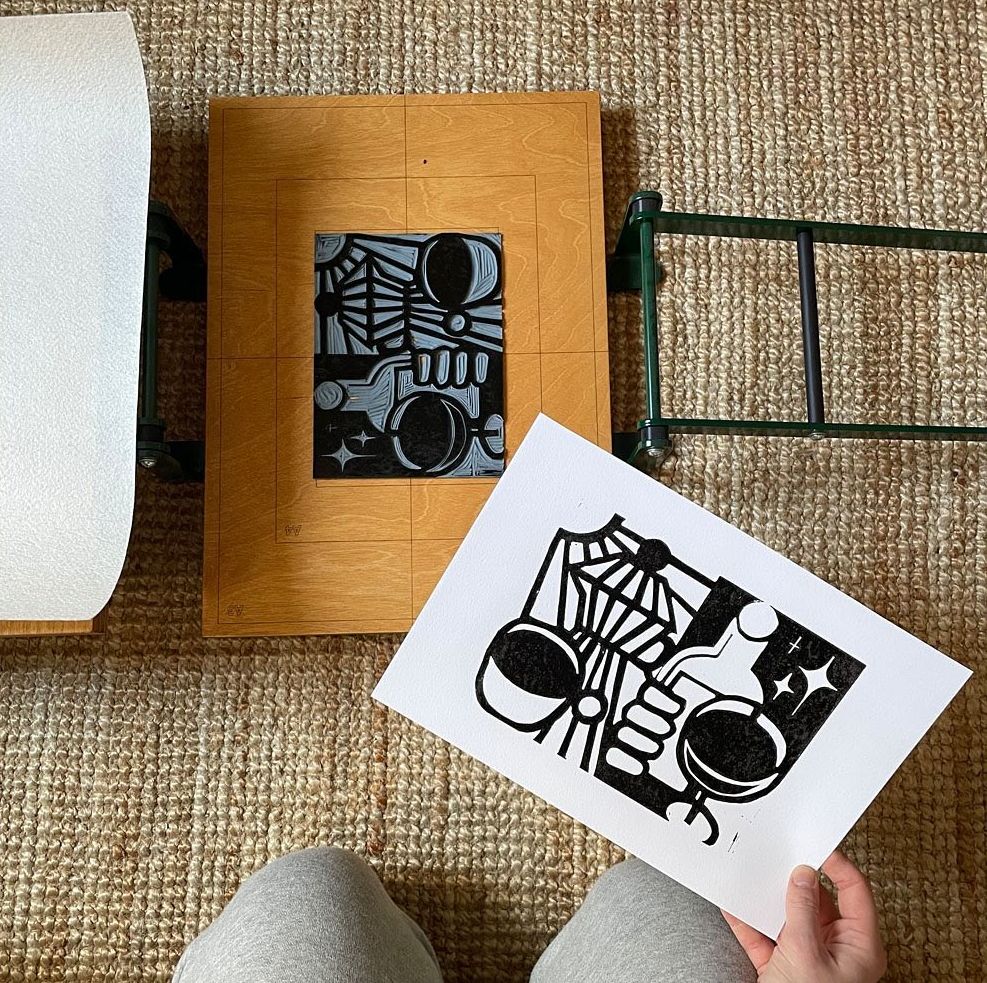
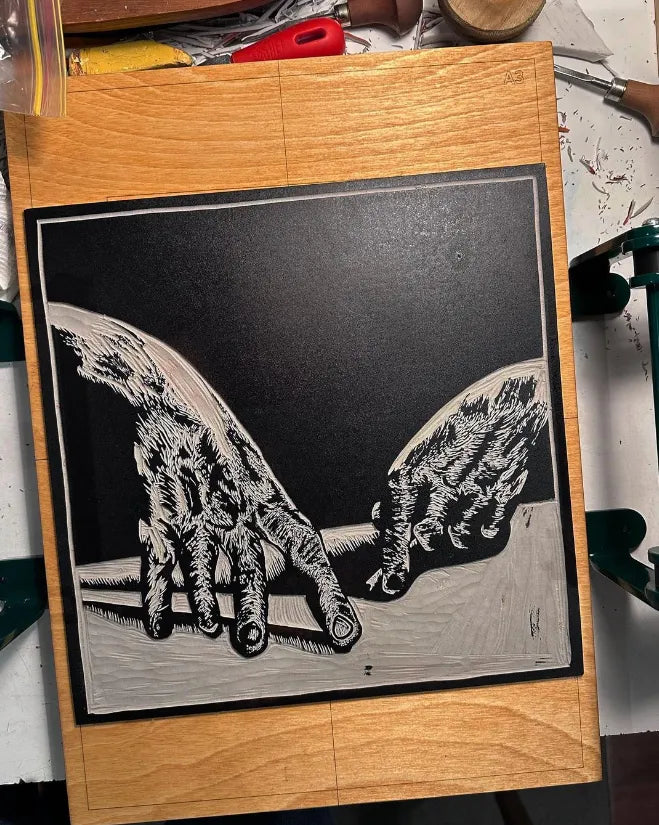
The Ritualis Press solves this with laser-burned centering lines on the bottom plate. These lines include a center cross and the outlines of standard paper sizes, permanently etched into the wood so they never wear off. You can place your linocut block and paper exactly on centre, every time, without measuring or using sticky tape as a guide.
Centering lines are rare on linocut presses at any price point. Most wooden presses - including many sold on Etsy and through marketplace sellers on eBay and Amazon - have bare bottom plates with no registration aids at all. The Ritualis Press centering system is one of the most practical advantages it offers for printmakers working with multi-colour linocut or who care about consistent positioning across an edition.

2. Two Levers
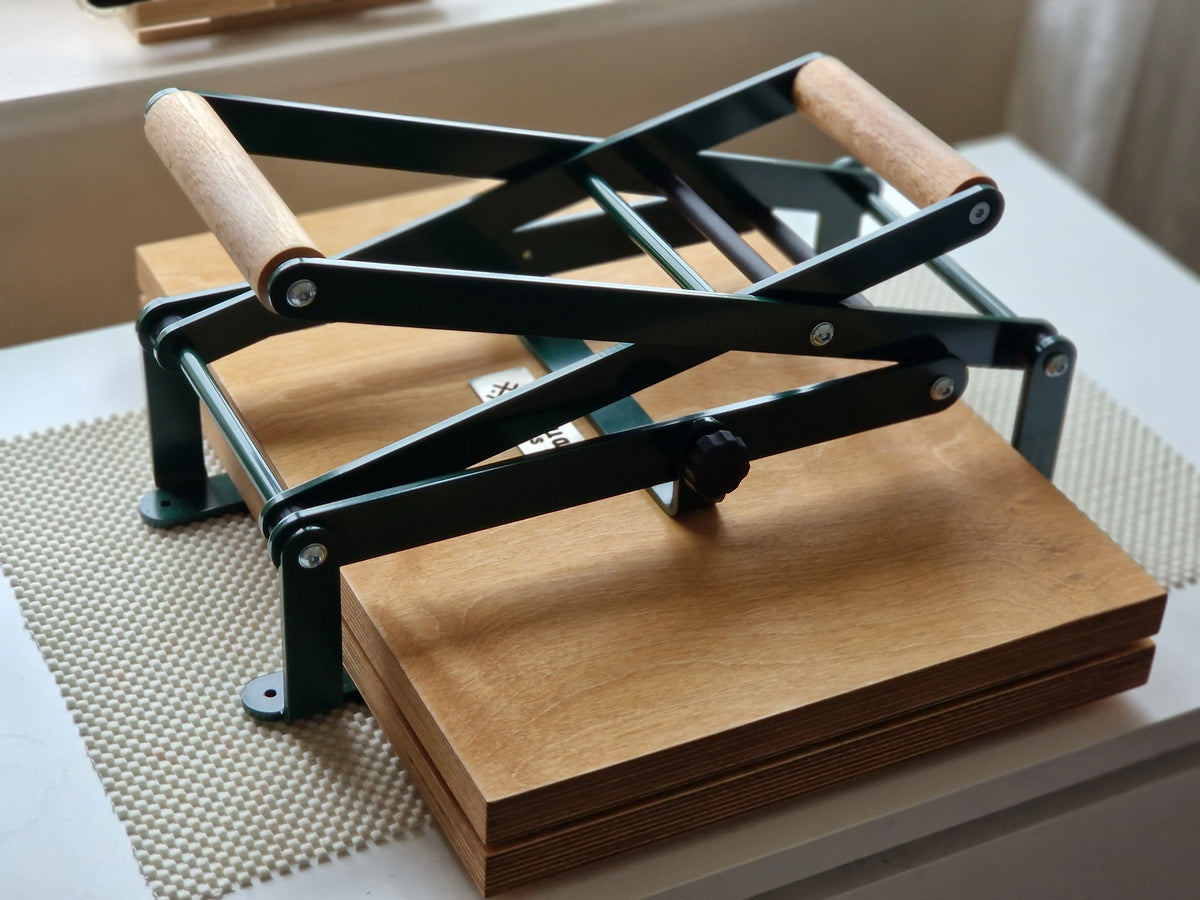
Every Ritualis Press linocut press, regardless of size, comes with two levers. This is not a feature reserved for the larger A3 model: the A4 and A5 presses include dual levers as standard.
The dual lever system allows you to lean on both handles simultaneously, distributing pressure evenly and allowing you to apply significantly more force than a single-lever press permits. Even when working with small linocut blocks, the two-lever design means you can achieve full, even ink transfer without fighting the press. For printmakers with hand or wrist fatigue, the ability to use both hands and body weight rather than grip strength makes a real difference over a long printing session.
Single-lever linocut presses - the most common configuration found in budget presses on Amazon and Etsy - require more effort to achieve comparable pressure, and the pressure is often less evenly distributed across the plate. The two-lever system on the Ritualis Press is a deliberate engineering decision, not an upgrade - it comes on every press, every size.

3. Full Edge Print
On many linocut presses, the pressing plate is the same size as the format it is designed for. This creates a practical problem: the edges of the plate do not press evenly because there is no overhang to maintain consistent pressure at the margins. The result is edges that print lighter than the centre, or that do not print at all.
The Ritualis Press pressing plates are enlarged by 1 cm on each side beyond the nominal format. An A4 press has plates larger than A4; an A3 press has plates larger than A3. This means the plate extends beyond the edge of your paper on all sides, so pressure is even from corner to corner. Full bleed linocut printing - ink to the very edge of the sheet - is straightforward on the Ritualis Press in a way that it simply is not on presses with exactly-sized plates.
This oversized plate design also makes paper insertion easier. There is room to slide the paper into position without lifting the top plate fully, which speeds up the printing process when you are working through an edition.

4. Adjustable Tilt
Linocut blocks vary in thickness. Battleship grey lino, Japanese vinyl, mounted lino on MDF, unmounted soft lino - each has a different height, and even within a single material batch, thickness can vary slightly. A press with a fixed top plate applies pressure unevenly when the matrix is slightly thicker on one side than the other, resulting in prints that are darker in one corner than another.
The Ritualis Press top plate has an adjustable tilt mechanism. Two tighteners on the sides of the press allow you to loosen the top plate, adjust its angle until it rests evenly on the surface of your specific matrix, and then lock it back into position. The press then maintains that calibrated tilt for the entire edition.
Adjustable tilt is absent on most linocut presses in this category. Fixed-plate presses require the printmaker to shim the matrix or compensate with packing paper - workarounds that add time and inconsistency. The Ritualis Press tilt adjustment removes this variable from the printing process entirely.

5. Stable and Portable
A linocut press that flexes or slides during printing is worse than no press at all: it introduces variability that is impossible to control. The Ritualis Press is built for genuine stability without sacrificing portability.
The combined thickness of the pressing plates is 48 mm, which gives the press enough mass and rigidity to maintain consistent pressure across the full printing surface without deflection. For permanent studio setups, the bottom of the press includes an attachment system that allows it to be fixed to a table or workbench, eliminating any possibility of movement during printing.
Despite the solid construction, the Ritualis Press is lightweight enough to carry to workshops, classes, and printmaking events. The A5 and A4 models are particularly suited to printmakers who teach, travel to residencies, or work in shared spaces. The presses store flat and take up minimal space when not in use - an important consideration for printmakers working from home studios with limited storage.
The felt pad included with every Ritualis Press purchase is part of this system: selected for the right thickness and density, it spreads pressure evenly across the entire printing surface and contributes to consistent results across every print in an edition.

6. Extremely Durable
The Ritualis Press frame is constructed from 5 mm thick steel flat bars - a significantly heavier gauge than the steel or aluminium used in most consumer linocut presses. The construction is complemented by specialist 3D-printed plastic pads that maximise stability at the contact points without adding unnecessary weight.
Every Ritualis Press model has been load tested to 100 kg. This is not a marketing figure: it reflects the actual structural engineering of the press and the real-world pressures that printmakers apply when pulling difficult prints from deeply carved blocks or dense lino.
The longevity of a linocut press depends on the quality of its pivot points, its frame, and its pressing mechanism. Wooden presses can warp with humidity changes, loosen at joints over time, and wear at the pivot under repeated high-pressure use. The steel construction of the Ritualis Press is unaffected by humidity and does not loosen at joints in the way that wood-framed presses do. A well-maintained Ritualis Press is a piece of printmaking equipment that should last decades.

7. Custom Laser Engraving
The Ritualis Press can be laser engraved with custom text of your choice - a name, a date, initials, or a short message applied directly and permanently to the press body. Each engraving is done exclusively for you, creating a tool that is unmistakably and permanently yours.
Custom laser engraving makes the Ritualis Press an exceptional gift for printmakers - for a birthday, a studio opening, a graduation, or as a personal milestone marker. A linocut press with a name on it is no longer just a tool: it is a keepsake.
8. Made in Europe
The Ritualis Press linocut printing press is designed and handmade in Czech Republic - in the heart of Europe. Every press leaves the workshop having been individually assembled and quality-checked, not pulled from a warehouse of mass-produced units.
Made in Europe means shorter shipping distances for European customers, lower carbon footprint per order, and no uncertainty about import duties or customs delays within the EU. It also means that if you ever have a question about your press, you are speaking directly to the people who built it.
The growing market for linocut presses on platforms like Amazon and eBay is dominated by presses manufactured in Asia at scale, where quality control is inconsistent and the supply chain between factory and customer is long. Buying a Ritualis Press means supporting a small European workshop that takes pride in every press it ships - and that stands behind its product with genuine after-sales care.
For printmakers who care about where their tools come from and how they are made, Made in Europe is not just a label. It is a commitment to craft, transparency, and a standard of production that a large-scale factory cannot replicate.
Alternatives
The linocut press market has grown significantly in recent years. Alongside the Ritualis Press, printmakers considering a dedicated linocut press will likely encounter Woodzilla Press, Pooki Presses and a wide range of unbranded presses sold on Etsy, eBay, and Amazon. Here is a straightforward comparison of what each category typically offers.
Woodzilla Press
Woodzilla Press produces traditional wooden linocut presses. Compared to the Ritualis Press, the primary differences are in construction material and in the feature set: the Woodzilla Press does not include the dual-lever system, laser-engraved centering lines, adjustable tilt, or the oversized plate design found on the Ritualis Press. Both brands are handcraft-oriented producers. Printmakers who prefer a warm wood aesthetic with more color options may prefer the Woodzilla; those who prioritise features, durability, and precision tend to favour the Ritualis Press.
Pooki Presses
Pooki Presses is a UK-based maker of handcrafted wooden linocut presses. Their presses are well-made wooden tools with a single-lever mechanism. The Pooki Press does not include centering lines, dual levers, adjustable tilt, or the oversized plate design. Pooki presses have a strong reputation for build quality within the UK market. The Ritualis Press offers more engineered features for printmakers who need precise registration and maximum pressure.
Marketplace Presses - Etsy, eBay, Amazon
The linocut press category on Etsy, eBay, and Amazon includes a wide range of presses from independent makers, small workshops, and mass-market suppliers. Quality varies enormously. At the lower end of the price range, these presses typically use thinner materials, single levers, fixed plates with no registration aids, and no tilt adjustment. They may be adequate for occasional use and simple single-colour printing. For printmakers who print regularly, work in editions, or require consistent results across multi-colour linocut prints, the construction and feature gaps compared to a purpose-built press like the Ritualis Press become apparent quickly. Mass-produced marketplace presses also typically come with no felt, no attachment system, and no load testing data.
At the higher end of the Etsy market, independent makers produce presses of genuine quality. These should be evaluated individually on their specific features, construction materials, and the maker's track record.
Feature Comparison
| Feature | Ritualis Press | Woodzilla Press | Pooki Presses | Generic Marketplace |
|---|---|---|---|---|
| Laser centering lines | Yes - all sizes | No | No | No |
| Dual levers | Yes - all sizes | No | No | No |
| Oversized plates (full edge) | Yes (+1 cm each side) - all sizes | No | No | No |
| Adjustable tilt | Yes - all sizes | No | No | No |
Note: Competitor specifications are based on publicly available information at the time of writing. Verify current specifications directly with each manufacturer before purchasing.
Who Is the Ritualis Press Lino Press For?
The Ritualis Press linocut printing press is designed for printmakers who want a serious tool: one that will support their practice for years without compromises in precision, durability, or ease of use. It suits beginners who want to invest once in a press that will not limit their development, and experienced printmakers who have outgrown improvised or entry-level setups.
The three sizes - A5, A4, and A3 - cover the full range of formats used in edition linocut printing. The A5 is ideal for small prints, card making, and textile printing samples. The A4 handles the most common linocut print format. The A3 opens up large-format linocut work, textile printing, and botanical pressing.
If you are comparing linocut presses and trying to decide between the Ritualis Press, a Woodzilla Press, a Pooki Press, or a marketplace press, the decision comes down to what you need from the tool. If precise registration, maximum pressure, full-edge printing, and long-term durability are priorities, the Ritualis Press is the most fully-featured option in its category. If you are happy with a more traditional wooden press and do not need centering lines, dual levers, or adjustable tilt, the other options are genuine alternatives worth considering.
Where to get inspiration for linocut prints?