

Mokuhanga is the traditional Japanese method of woodblock printing. An image is carved into a wooden block, water-based pigment mixed with rice paste is brushed onto the raised surface, and dampened Japanese paper is printed by hand with a baren. No press, no oil and no solvents are needed. The result is soft, luminous colour that sinks into the paper instead of sitting on top of it.
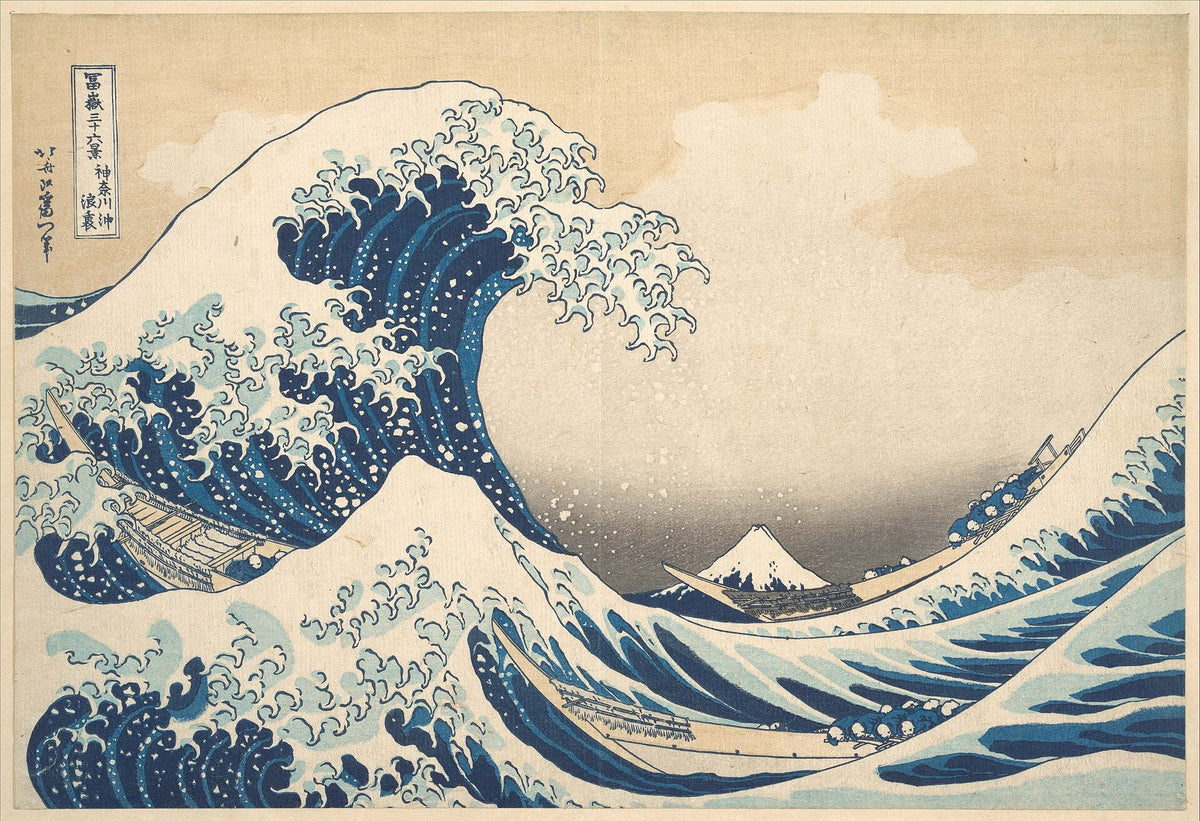
It is the technique behind Hokusai's Great Wave, and it is enjoying a quiet revival among printmakers around the world. This guide explains what mokuhanga is, where it came from, which tools it uses, how a print is made and how it differs from woodcut and linocut.

What Is Mokuhanga?
The word combines moku (木), meaning wood, and hanga (版画), meaning print. Literally, it is a "wood print". Mokuhanga is a form of relief printing: the areas carved away stay blank, while the raised surface carries the colour.
The term is often confused with ukiyo-e, but the two are not the same thing. Mokuhanga is the process: how a block is carved, inked and printed. Ukiyo-e, or "pictures of the floating world", is a historical genre of Edo-period art that was largely produced with that process. A contemporary artist in Berlin or Toronto can make mokuhanga, but would not be making ukiyo-e.
A Short History of Japanese Woodblock Printing
From China to the Buddhist temples
Woodblock printing developed in China and reached Japan in the eighth century. The earliest documented Japanese example dates from 764, when Empress Kōken commissioned one million miniature wooden pagodas, each holding a small printed Buddhist text known as the Hyakumantō Darani. They were distributed to temples in thanks for the suppression of the Emi Rebellion. For the next few centuries, printing remained almost entirely in the hands of Buddhist temples, which produced sutras and devotional images.

The Edo period and the publisher system
During the Edo period (1603 to 1868), rising literacy and a growing urban public turned printing into a commercial business. Publishers issued guidebooks, novels, theatre programmes and single-sheet pictures at prices ordinary people could afford. Production was divided between specialists: an artist drew the design, a carver cut the blocks, a printer pulled the sheets and a publisher, or hanmoto, financed and sold the work. This division of labour made it possible to produce large, consistent runs of high quality.

From black lines to full colour
The first prints were black only (sumizuri-e), with colour sometimes added by hand in styles such as tan-e and beni-e. Printing in two or three colours followed with benizuri-e. The decisive step came with the kentō, a pair of registration marks carved into each block so that the paper lands in exactly the same position every time. In the 1760s, Suzuki Harunobu used this precision to develop nishiki-e, or "brocade pictures": full-colour prints built from many separate blocks.

Hokusai, Hiroshige and the world stage
Mokuhanga reached its best-known heights in the nineteenth century. Katsushika Hokusai (1760 to 1849) published Thirty-Six Views of Mount Fuji around 1830 to 1832, and the series made landscape a major subject of Japanese prints. Utagawa Hiroshige (1797 to 1858) followed with lyrical travel scenes and his late masterpiece, One Hundred Famous Views of Edo.


When Japanese prints reached Europe, their flat colour, bold cropping and asymmetrical compositions influenced the Impressionists and the wider movement known as Japonisme. Vincent van Gogh admired them so much that in 1887 he painted his own copy of Hiroshige's Plum Garden at Kameido.

Shin-hanga and sōsaku-hanga
Photography and modern printing ended the commercial dominance of ukiyo-e, but the craft did not disappear. In the early twentieth century it divided into two movements. Shin-hanga ("new prints"), promoted by the publisher Watanabe Shōzaburō from around 1915, kept the collaborative workshop system and blended traditional subjects with Western light and atmosphere. Kawase Hasui and Hiroshi Yoshida are its best-known artists.


Sōsaku-hanga ("creative prints") took the opposite approach. Its artists designed, carved and printed their own work as a form of personal expression. Yamamoto Kanae's Fisherman of 1904 is usually regarded as its starting point, and Onchi Kōshirō and Munakata Shikō became two of its leading figures.

Mokuhanga today
Both approaches are still alive. Workshops such as the Adachi Institute of Woodblock Prints and David Bull's Mokuhankan continue the traditional division of labour, while independent artists around the world carve and print alone, often combining mokuhanga with other techniques. Its appeal today is easy to understand: it needs no press, uses non-toxic materials and fits on a kitchen table.
Mokuhanga Tools and Materials
Wood
Historically, blocks were cut from fine-grained mountain cherry. Today, the most popular choice is shina (Japanese linden) plywood, which is affordable, soft to carve and has an almost invisible grain. Katsura and magnolia are good solid alternatives, and Baltic birch plywood is a widely available option for practice.
Carving tools
The signature tool is the hangi-tō, a knife held upright in the fist and used to outline shapes on both sides of a line. Wood is then cleared with chisels and gouges. Sharp carving tools matter even more here than in linocut, because wood grain will tear under a dull edge.
Pigment and nori paste
Mokuhanga uses water-based colour: liquid pigment, watercolour, gouache or sumi ink. A small amount of nori, a rice-starch paste, is added on the block. It helps the pigment spread evenly and gives the printed colour its depth.
Brushes
Instead of a brayer, pigment is applied with round printing brushes known as hanga bake, worked in small circular movements. A brush allows far more control than a roller and makes it possible to blend one colour into another on the block.
Washi paper
Washi is Japanese paper, traditionally made from the long, strong fibres of kozo (paper mulberry) or the silky fibres of gampi. Its strength is essential: the sheet must stay stable while damp and survive repeated rubbing without distorting, otherwise the colours will fall out of register.
The baren
The baren is the flat, hand-held disc used to press the paper onto the block. A traditional hon baren consists of a coil of twisted bamboo-fibre cord inside a rigid backing disc, wrapped in a bamboo sheath. Modern versions in wood, glass, plastic or with ball bearings are more affordable and work well for learning.

How a Mokuhanga Print Is Made
- Plan the colours. Divide your design into layers, usually one block per colour, and decide the printing order from lightest to darkest.
- Transfer the design. Traditionally, the drawing is made on thin paper and pasted face down on the block, so the final print reads the right way round.
- Carve the key block and kentō. Cut the key block with the main lines, and carve an L-shaped corner and a straight guide into the block as registration marks.
- Carve the colour blocks. Print the key block onto thin paper, transfer those proofs to the other blocks, and carve one colour on each.
- Dampen the paper. Moisten the sheets and rest them in a stack, wrapped in plastic, so that the moisture spreads evenly.
- Brush on pigment and nori. Add a few drops of pigment and a little paste to the block, then brush them into an even film.
- Print with the baren. Place the paper into the kentō, lower it onto the block and rub the back in zigzag or circular movements.
- Repeat and layer. Print each colour in turn, keeping the paper damp between layers. Thin, transparent layers build depth that a single opaque coat cannot achieve.
- Dry flat. Dry the finished prints between sheets of blotting paper under light weight so that they stay flat.
Mokuhanga vs Woodcut vs Linocut
All three are relief techniques, but they feel and look very different.
| Mokuhanga | Western woodcut | Linocut | |
|---|---|---|---|
| Block | Shina, cherry | Side-grain wood | Linoleum |
| Ink | Water-based pigment with nori | Usually oil-based | Oil-based or water-based |
| Applied with | Brush | Roller | Roller |
| Printed with | Baren | Press or baren | Press or baren |
| Paper | Damp washi | Usually dry | Usually dry |
| Look | Soft, translucent, layered | Bold, textured | Graphic, crisp |
The difference from wood engraving lies in the block itself. Engravers cut the hard end grain with a burin for very fine lines, while mokuhanga is carved into the softer side grain. For a closer look at the Western approach, read our guide to woodcut printmaking.
How to Start With Mokuhanga
You can begin with a small block, two or three colours and a simple design. If you already make linocuts, much of your kit and experience carries over. Our lino cutting set is useful for clearing areas, and a wooden baren or glass baren will let you practise the hand-printing movement. A palette knife helps with mixing colour.
Brushes, nori paste, shina plywood and washi are specialist materials that we do not stock, so you will need a Japanese printmaking supplier for those. To learn more about printing by hand, read our article on the wooden baren and our guide to paper for hand printing.
Frequently Asked Questions About Mokuhanga
Is mokuhanga the same as ukiyo-e?
No. Mokuhanga is the printing technique, while ukiyo-e is an art genre of the Edo period that was mostly produced using that technique.
Do you need a press for mokuhanga?
No. Mokuhanga is traditionally printed entirely by hand with a baren. Some contemporary artists experiment with presses, but hand printing is what defines the process.
What paint is used in mokuhanga?
Mokuhanga uses water-based colour such as liquid pigment, watercolour, gouache or sumi ink, mixed on the block with nori rice paste.
What is the best wood for a beginner?
Shina plywood is the usual recommendation. It is affordable, easy to carve and has a fine grain that prints smoothly.
Can you do mokuhanga on linoleum?
You can practise brushing water-based colour and printing with a baren on linoleum, but lino does not absorb and release moisture the way wood does. For the characteristic soft, layered colour, a wooden block works best.
Sources and Further Reading
- Woodblock printing in Japan, Wikipedia
- Mokuhanga: Japanese Woodblock Printmaking, Jackson's Art
- Mokuhanga, World of Printmaking
- WTF is Mokuhanga?!, Jason Fujiwara
Famous Linocut Artists: Masters of Lino Print Art