

Linocut printing has attracted some of the most significant names in modern art. From the early German Expressionists who carved the first linocuts at the turn of the twentieth century, to Pablo Picasso who turned the technique into a vehicle for bold, multi-colour work, the list of famous linocut artists spans continents, movements and a full century of printmaking history. This guide introduces the most influential lino print artists in history, with short biographies and the works that defined their approach to the medium.
What drew these artists to linocut? The answer is almost always the same: directness. The cut cannot be undone. The image must be planned in reverse. The result, when printed, has an immediacy and graphic strength that few other printmaking techniques can match. These are the artists who understood that quality best - and whose work continues to inspire printmakers today.
Erich Heckel - The First Linocut

Erich Heckel (1883–1970) holds a unique place in printmaking history: he is credited with making the first known linocut in 1903. A founding member of the German Expressionist group Die Brücke (The Bridge), co-founded in Dresden in 1905 alongside Ernst Ludwig Kirchner, Fritz Bleyl and Karl Schmidt-Rottluff, Heckel used printmaking as a primary vehicle for expressing raw emotion rather than depicting the world accurately.
Die Brücke embraced relief printing for its rawness. Woodcuts and linocuts allowed the group to produce bold, distorted images that prioritised psychological intensity over anatomical accuracy. Heckel's prints from the 1900s and 1910s are among the defining documents of German Expressionism, and his role in pioneering linocut placed the medium at the centre of one of the most important art movements of the early twentieth century.
After the First World War, Heckel's work became quieter and more lyrical, but his commitment to printmaking remained constant throughout his long career. His first linocut preceded the spread of the medium into schools and studios across Europe - a spread that would, within a generation, attract artists of the stature of Picasso, Matisse and Kandinsky.

M.C. Escher - Infinite Worlds on Paper

Maurits Cornelis Escher (1898–1972) is among the most recognised graphic artists of the twentieth century, celebrated worldwide for his mathematically inspired prints of impossible architectures, transforming tessellations and infinite staircases. His relationship with linocut began early: at seventeen, he carved a linocut portrait of his father - considered his first significant printmaking work - before going on to study at the School of Architecture and Decorative Arts in Haarlem.
Though Escher became better known for his woodcuts and lithographs, he returned to linocut for one of his most admired late works: Rippled Surface (1950), printed from two blocks - one for the still, reflected sky and one for the circular ripples spreading across the water's surface. The print demonstrates the medium's capacity for precise tonal gradation when handled with exceptional skill and patience.
Escher was a member of the printmaking society De Grafische in The Hague, where he worked alongside Gerd Arntz and other Dutch graphic artists. The museum dedicated to his work - Escher in The Palace in The Hague - remains one of the most visited printmaking museums in Europe.
Pablo Picasso - The Reduction Linocut Master

Pablo Picasso (1881–1973) needs no introduction as a painter, but his contribution to linocut is less widely known - and no less significant. Working in Vallauris in the south of France during the late 1950s and 1960s, Picasso became fascinated by the reduction linocut technique, a method in which a single block is progressively cut and printed in multiple colours, destroying each layer as the next is added and making the edition impossible to reprint.
The reduction process appealed to Picasso for the same reason it demands courage from every printmaker who uses it: once a layer is cut, the previous state is gone. The print must be planned from the final image backwards. His reduction linocuts - including Bacchanal with Goat (1962) - are vivid, complex, multi-layered works that transformed what linocut could achieve in terms of colour depth and compositional richness.
Though it is debated whether Picasso invented the reduction technique himself, his work brought it to international attention and demonstrated to artists worldwide that linocut was a medium worthy of the most ambitious printmaking ambitions.
Henri Matisse - Line, Light and the Printed Page

Henri Matisse (1869–1954) is best known as a painter of joyful colour, but his printmaking work - particularly his linocuts from the 1940s - reveals an artist equally in command of black and white. Matisse made linocuts primarily as book illustrations, most significantly for Pasiphaé: Chant de Minos (Les Crétois) (published 1944), a volume containing 51 linocuts that rank among the most elegant works in the medium's history.
Matisse's approach to linocut was characteristically direct: he drew with the gouge rather than transferring a preparatory drawing to the block, allowing the tool to generate the image spontaneously. The resulting lines have a fluency and confidence that reflect decades of draftsmanship. His print Dors, Dormeuse aux Longs Cils (Variant IV) (1944) - a sleeping figure reduced to the essential curve of a single continuous line - is one of the most serene prints in the entire canon of twentieth-century printmaking.
Where other artists used linocut's natural tendency toward bold, angular marks, Matisse found softness and flow in a technique more often associated with graphic strength than lyrical grace.
Wassily Kandinsky - Abstract Line on Lino

Wassily Kandinsky (1866–1944) is recognised as one of the founders of abstract art, and his linocut work is an early chapter in that journey. Due Ragazze (Two Girls) (1907) - made just years before Kandinsky's decisive break into pure abstraction - shows an artist already moving away from representational imagery toward a visual language of colour, line and rhythm.
Due Ragazze was made using multiple colour blocks, producing a flat, decorative surface with the patterned, ornamental quality typical of Kandinsky's Munich period. The image - two stylised female figures set against a richly coloured ground - reflects the influence of Japanese woodblock printing and Jugendstil design. Its surface rhythm points unmistakably toward the colour-field and compositional work Kandinsky would develop in later years at the Bauhaus.
Kandinsky's engagement with linocut was relatively brief but productive. His linocuts are valuable early documents of a moment when abstract art was developing its first visual language - a language that would change the course of twentieth-century painting entirely.

Sybil Andrews - Speed, Labour and the Modern Body
Sybil Andrews (1898–1992) produced some of the most dynamic linocuts in the history of the medium. Working in London in the 1920s and 1930s at the Grosvenor School of Modern Art under Claude Flight, Andrews developed a style rooted in Futurism and Vorticism - capturing the sensation of speed, effort and motion in prints of labourers, cyclists, rowers and athletes.
Her print Racing (1934) is considered one of the finest British linocuts of the interwar period: cyclists lean into a bend at extreme angle, their figures abstracted into repeated, rhythmic diagonals that communicate velocity as much as physical form. The linocut's natural tendency toward simplified, flattened shapes suited Andrews's subject matter perfectly - no other medium could have expressed the energy of modern sport and industrial labour more directly.
Andrews emigrated to Canada in 1947, settling in British Columbia, where she continued to print until late in her life. Her works are held in major collections including the Tate Gallery, London, and the Glenbow Museum, Calgary.
Elizabeth Catlett - Linocut as Social Witness
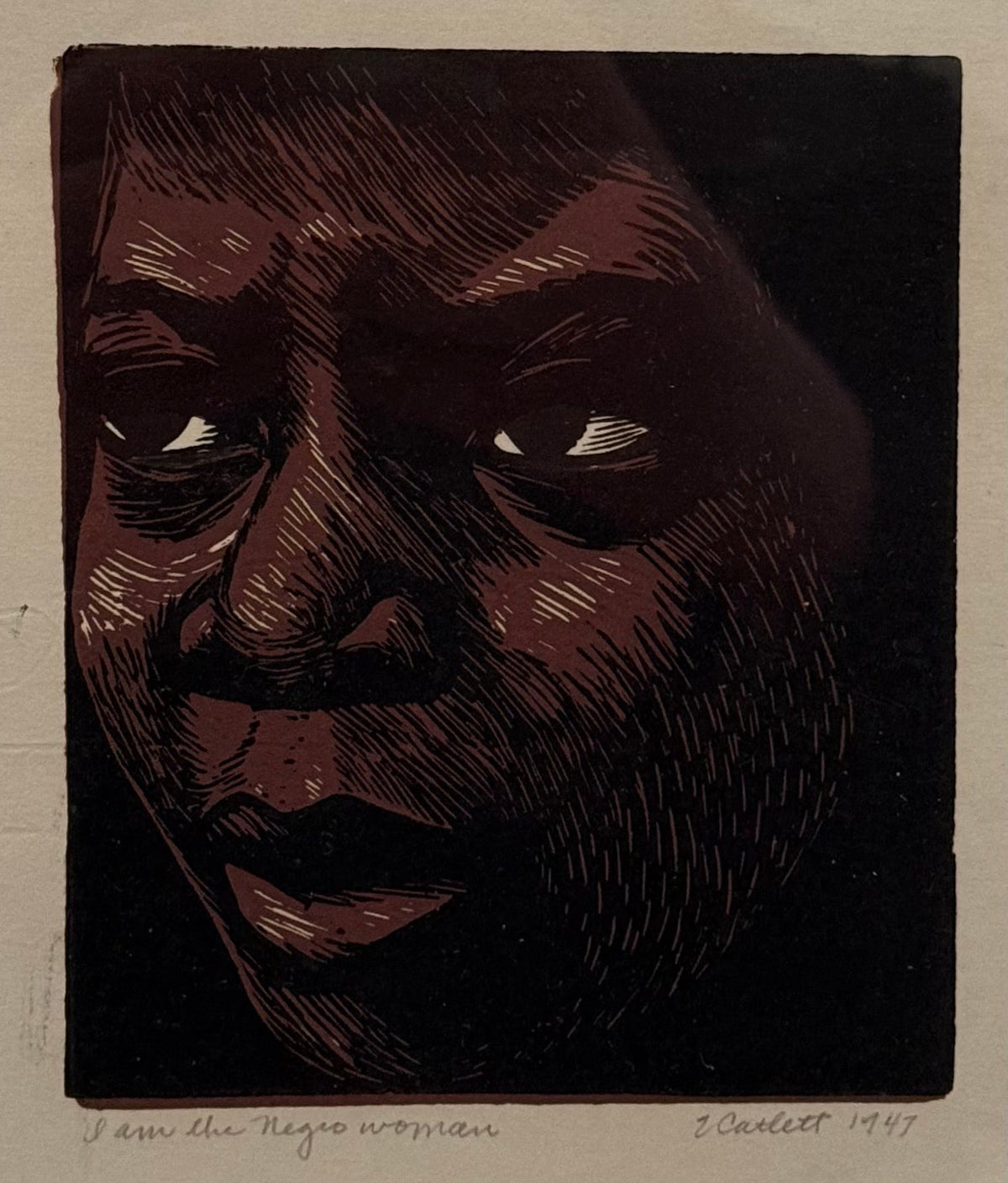
Elizabeth Catlett (1915–2012) used linocut as a form of witness. An African-American sculptor and printmaker who spent much of her adult life in Mexico, Catlett made prints that documented the lives of Black women in America and Mexico with directness and dignity, placing her work at the intersection of art, race and civil rights.
Her linocut Sharecropper (1952) - a close portrait of a Black woman in a sunbonnet, her face calm and weathered - is one of the most reproduced images in American printmaking. Catlett trained under Grant Wood in Iowa and later at the Taller de Gráfica Popular in Mexico City, an artist collective that used print as a tool for political communication. Her technique was precise and unsparing: faces in her prints are always individuated, never generic.
Catlett believed that art should serve the community it depicted, and her linocuts were priced to be accessible. She described her work as being made first for Black people, and then for all people. Her prints are held in the Museum of Modern Art (MoMA) in New York and the Library of Congress in Washington D.C.

Edward Bawden - The British Illustrator
Edward Bawden (1903–1989) was one of Britain's most versatile graphic artists: a painter, illustrator, wallpaper designer and printmaker whose work moved between fine art and commercial application with unusual ease. Trained at the Royal College of Art alongside Eric Ravilious, Bawden developed a distinctive graphic style characterised by precise observation, dry wit and a sustained interest in architectural and urban subject matter.
His linocuts of London - including Liverpool Street Station (1961), a densely populated composition of figures, columns and Victorian ironwork - demonstrate linocut's capacity for documentary precision when handled by an artist with a draughtsman's eye and a graphic designer's instinct for the page. Bawden's work was widely reproduced through the mid-century: his designs appeared on London Transport posters, Penguin book covers, fabrics and in advertising campaigns.
Bawden's combination of commercial acuity and genuine artistic rigour made him an influential figure in British printmaking. His lino prints were exhibited at the Victoria and Albert Museum, and his work remains a touchstone for graphic artists interested in the overlap between illustration and fine art print.
Margaret Preston - Australian Modernism in Linocut

Margaret Preston (1875–1963) was the most important printmaker in Australian art of the first half of the twentieth century. A tireless advocate for an Australian visual identity grounded in the country's own flora, fauna and Indigenous art forms, Preston used linocut to give her modernist designs the graphic strength she believed Australian art needed to distinguish itself from its European sources.
Her linocut West Australian Banksia (1929) is representative of her approach: a native Australian plant reduced to its essential shapes, simplified and flattened into bold blocks of black and white that bear the influence of Japanese woodblock printing and the decorative Modernism of the period. Preston was an avid collector of Japanese prints and saw the flat, patterned quality of woodcut and linocut as natural vehicles for the visual language she was developing.
Preston's work was exhibited in Australia and Britain during the 1920s and 1930s, and her advocacy for a distinctly Australian modernism made her an influential figure. Her linocuts are held in the National Gallery of Australia and state gallery collections across the country.
Try Linocut Yourself
The artists in this guide worked across different centuries, continents and movements, but each found in linocut a medium of exceptional directness and expressive power. The technique Erich Heckel pioneered in 1903, and that Picasso, Matisse and Kandinsky each explored in their own way, remains as alive today as it was at the start of the twentieth century.
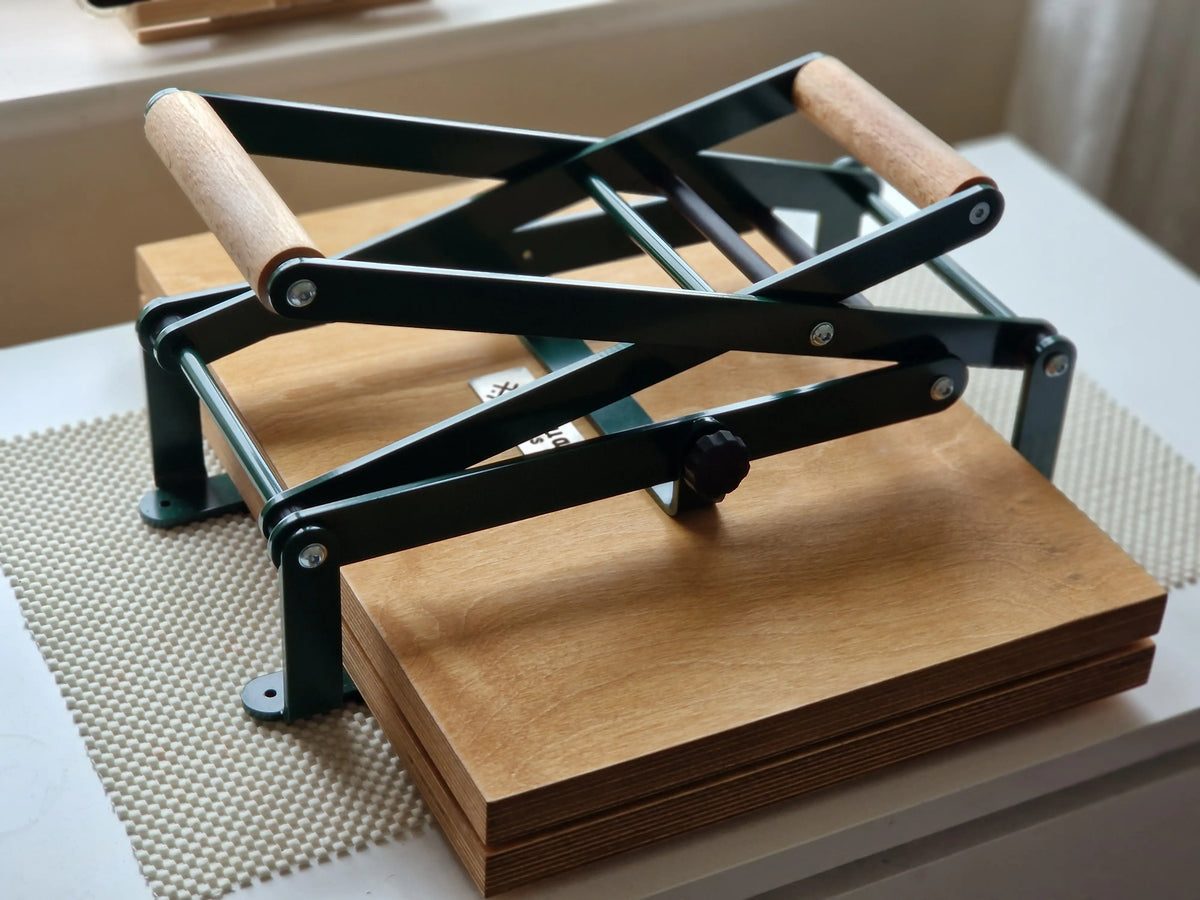
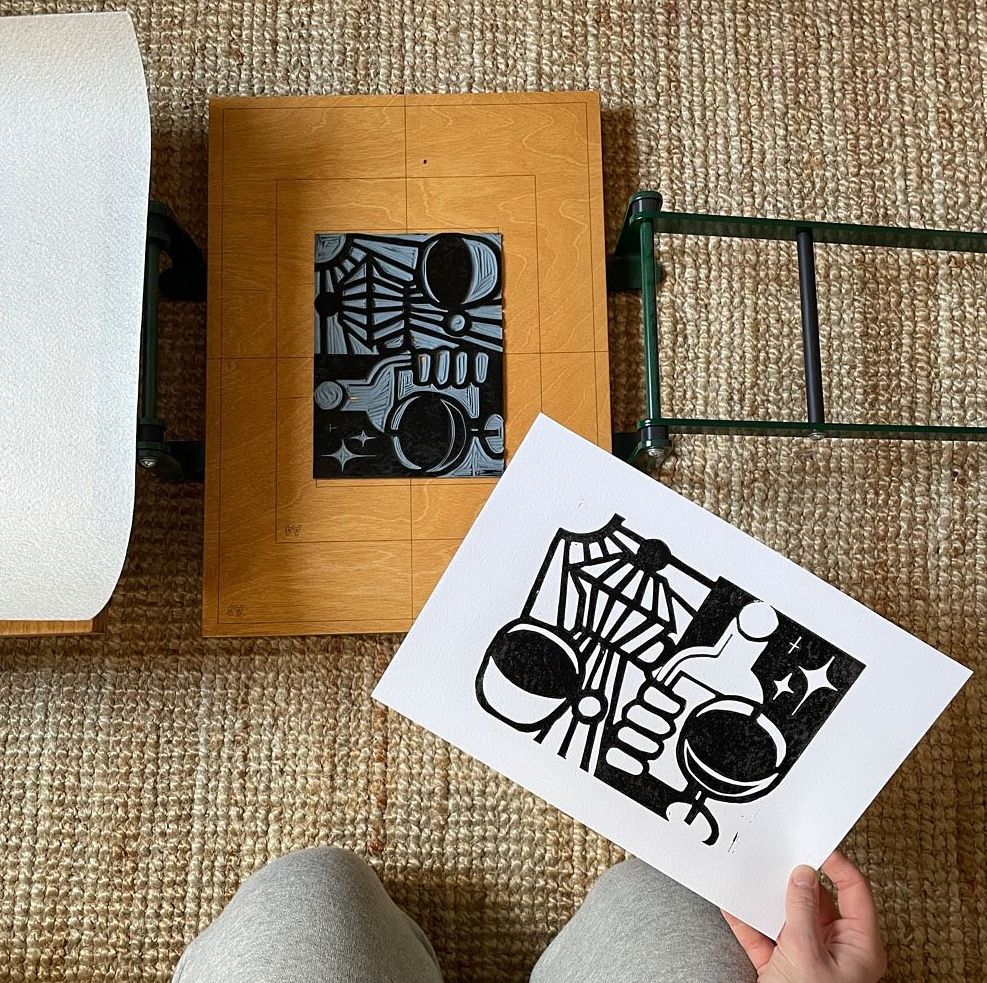
If their work has inspired you to try linocut for yourself, the right equipment makes a significant difference. The Ritualis Press linocut printing press is designed for printmakers who want precision, stability and durability. Available in A5, A4 and A3 sizes, it includes laser-engraved registration lines, dual levers and adjustable tilt. For more on the history of the medium that connects all these artists, read our guide to the history of lino printing and its artists.
8 Reasons to Choose the Ritualis Press Lino Press